

Automated futures trading strategies basically let computers handle your trades based on rules you set up beforehand. That cuts down on emotional execution errors and lets the system keep monitoring when you're away. These systems can monitor markets continuously, evaluate the conditions you programmed, and submit orders faster than you could manually.
If you're still figuring out what futures trading is, jumping into automation might seem like skipping steps. Once you get the basics down, bots can make rule-based execution a lot easier.
Automated Trading vs. Algorithmic Trading: Where They Overlap
Automated trading and algorithmic trading overlap heavily. An algorithm can be as simple as "sell my crude oil if it drops 2%" or as complex as a multi-factor execution model. "Automated" mainly tells you the software can place or manage trades without manual clicks; "algorithmic" tells you the decisions follow programmed rules. In practice, the same system can be both.
Think of it like hiring a digital employee that never needs coffee breaks, never panics during crashes, and follows your exact instructions without getting distracted. That's automated trading: software following your rules and placing or managing trades without manual clicks.
You don't need to be a programmer to start. Visual builders cover basic rule-based strategies: entries, exits, simple if-then logic. That's most of what you'll want early on. More custom logic usually needs scripting, and that's where most of us hit the wall.
Key Benefits of Using Bots in Futures Markets
Speed is one place automation has a clear advantage: once a rule triggers, software can submit an order without waiting for you to read, interpret, and click.
Say you're trading crude oil when a major supply headline hits. A bot following a prewritten rule can react immediately, although you're still exposed to slippage, latency, and the chance that the rule itself is wrong.
Advanced setups monitor multiple timeframes simultaneously: breakouts on 5-minute charts while confirming hourly trends, executing across three energy contracts with proper risk management. Try that manually.
Emotional removal matters more than people realize. Bots don't care about yesterday's losses or "lucky feelings." No revenge trading or overconfidence mistakes.
Futures trading automation can keep monitoring overnight sessions and pre-market volatility while you're sleeping.
Popular Automated Strategies for Futures
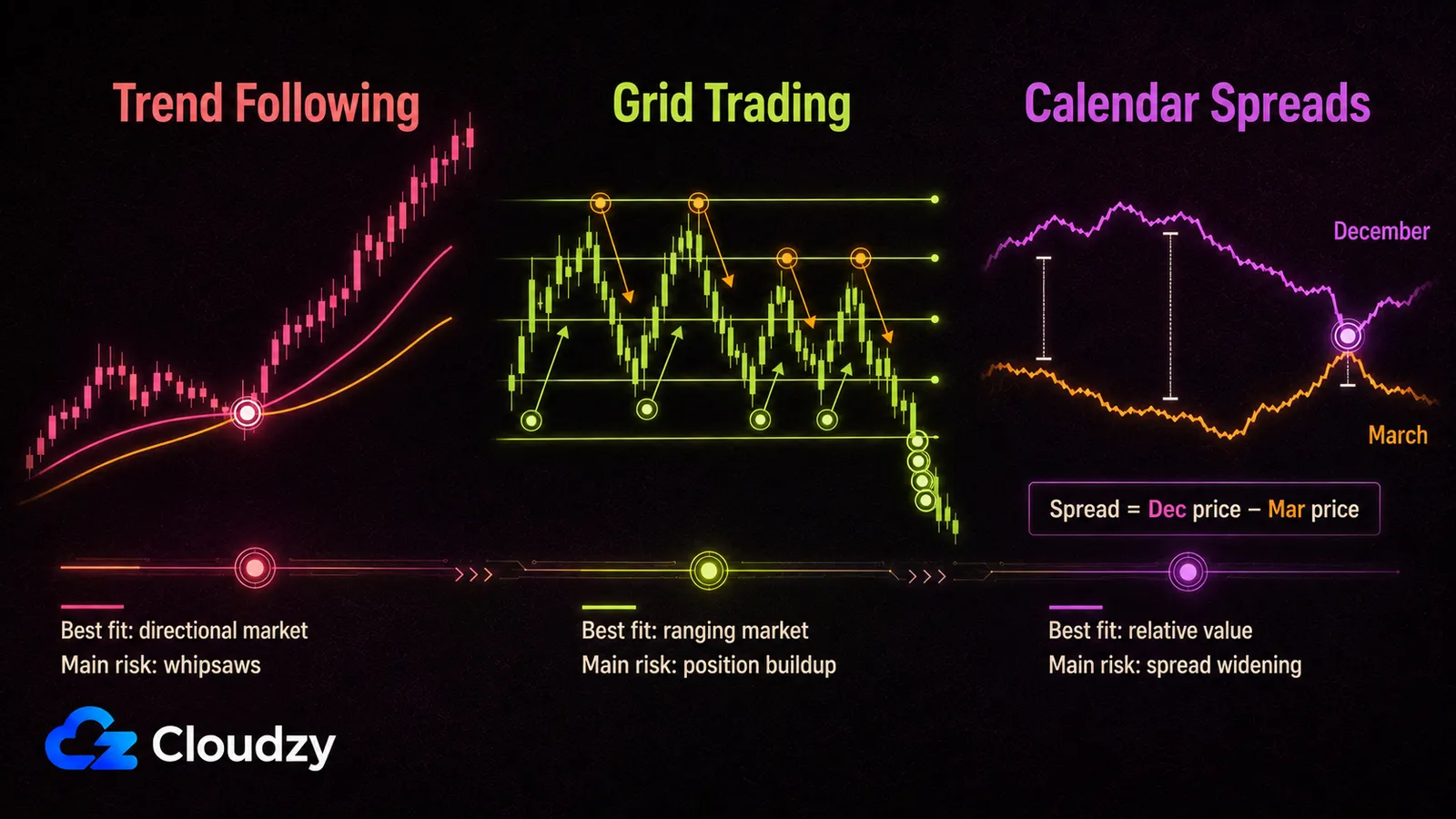
There's no single best automated futures strategy for every market. Trend systems want direction. Grids want a range. Calendar spreads trade the relationship between two contract months. For a first bot, trend following is usually the simplest of the three to express as clear entry and exit rules.
Trend Following: The Market Momentum Capitalist
Like surfing: you don't create momentum, you just ride it intelligently. Bots identify directional moves in futures prices and jump aboard.
Beginner example: Moving average crossover on E-mini S&P futures. When 20-day crosses above 50-day, buy one contract. Cross below, sell. At a hypothetical 4,000 index level, one ES contract has $200,000 of notional exposure (4,000 × $50). A 50-point move changes the contract's P&L by $2,500 before commissions and slippage, in either direction.
Advanced: Multi-timeframe momentum systems analyzing hourly, daily, weekly trends simultaneously. Bots can wait until the configured signals align, then use volatility-adjusted sizing. That's systematic futures trading strategies versus emotional decisions.
Grid Trading: Working a Range
Grid strategies treat markets like fishing nets, placing buy/sell orders at regular intervals around current prices. It's designed for ranging markets, where price repeatedly moves through the same levels.
Setup: Oil at $75? Buys every $10 below ($65, $55, $45), sells above ($85, $95, $105). Each completed cycle aims to profit from the move between grid levels.
Risk: Oil breaks below $50 and keeps falling. Your grid gets "run over" with multiple losing longs. Advanced grids use dynamic spacing and drawdown limits. Bot strategies for futures require careful risk management.
Calendar Spreads: Trading Relative Value Between Contracts
Calendar spreads trade changes in the price relationship between two expirations of the same futures market. That's different from risk-free arbitrage: the spread can keep moving against you.
Example: December corn trades $0.20 above March when your tested strategy expects a $0.05 spread. If the relationship narrows to $0.05 after the bot sells December and buys March, that's a $0.15-per-bushel gross move, or $750 across 5,000 bushels before fees and slippage. Technical futures trading indicators can still help with timing, but the trade itself depends on the relationship between the two contract months.
Risk: if you leg the trade separately, one side can fill before the other, and the spread can keep widening after you're in. You have less outright market-direction exposure than a naked long or short, but the spread itself can still move hard against you.
| Strategy | Best For | Main Risk | Example P&L |
|---|---|---|---|
| Trend Following | Directional markets | Whipsaws in choppy markets | ±$2,500 for a 50-point ES move |
| Grid Trading | Ranging markets | Position buildup in sustained trends | Depends on spacing and completed cycles |
| Calendar Spreads | Relative value between contract months | Spread widening | +$750 if the corn spread narrows by $0.15/bushel |
Platforms and Tools to Run Your Bots
For no-code or low-code setups, NinjaTrader has a point-and-click Strategy Builder, while MetaTrader 5's MQL5 Wizard can generate basic Expert Advisors from selected signals, money-management rules, and trailing-stop modules. Neither removes the need to understand what the strategy is doing.
Futures trading algorithms range from simple to institutional-grade. Pine Script builds custom strategies for backtesting and forward testing on TradingView, but TradingView doesn't currently execute Pine strategies directly through connected brokerage accounts. NinjaScript gives you deeper automation inside NinjaTrader and is C#-based.
Demand these features:
- Historical backtesting with realistic slippage
- Paper trading validation
- Built-in risk controls
- Maximum daily losses, position limits, emergency stops
Broker APIs let your bot submit and manage orders through your brokerage account without manual clicks. That's a common path once you outgrow platform-native builders.
VPS Hosting: When an Always-On Server Helps
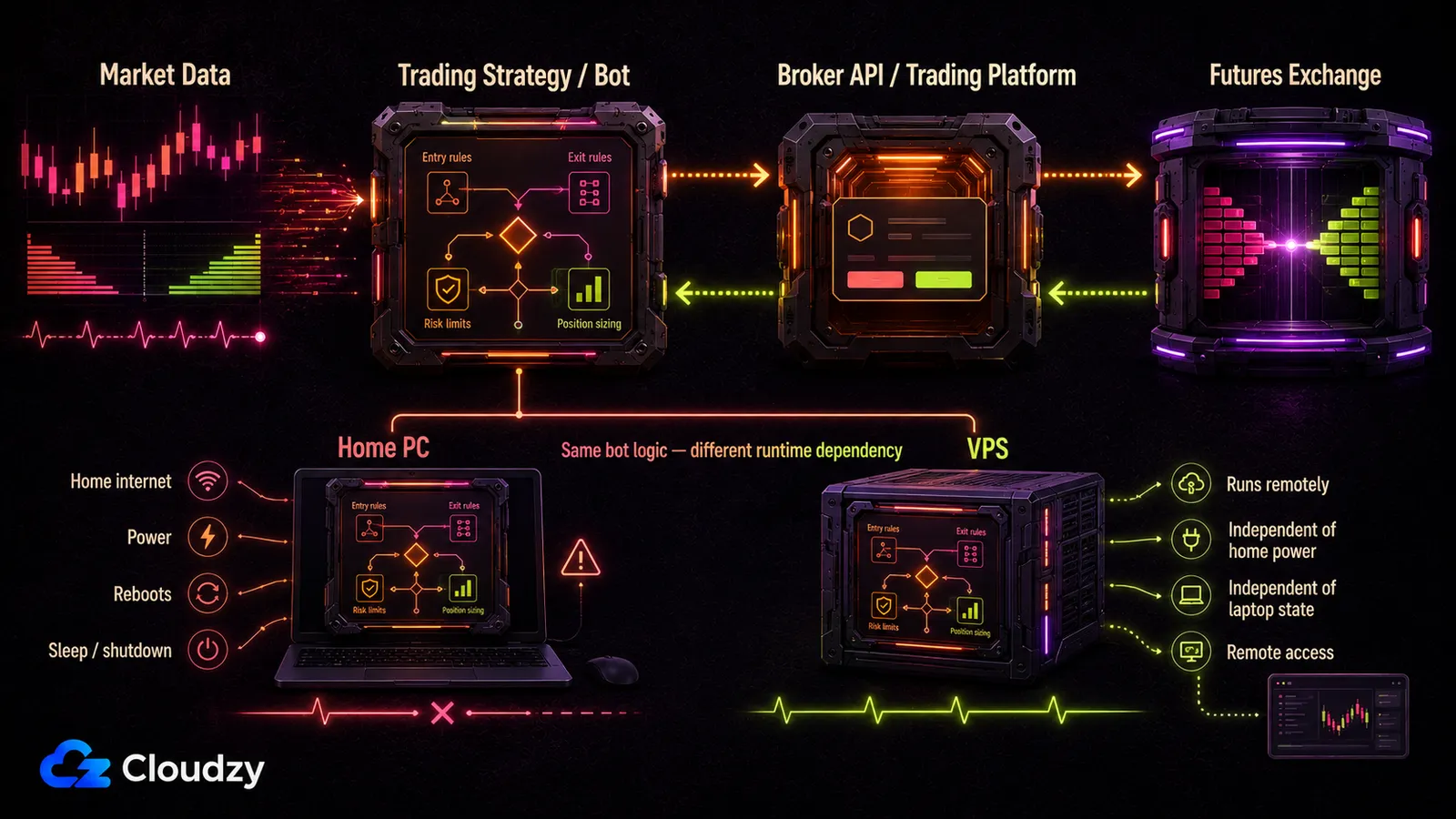
If your bot runs on your own PC, your home internet and power become part of the trading stack. An outage, reboot, or platform crash can stop the bot until you recover it.
A Forex trading VPS moves that runtime to a datacenter instead. Cloudzy backs the service with a 99.95% uptime SLA, so your bot is no longer tied to whether your laptop is awake or your home connection is healthy.

Keep your trading online 24/7 with a low-latency Forex VPS.
Get Trading VPSHow to Avoid Common Automation Pitfalls
Over-optimization can make a backtest look amazing and still fall apart live because the strategy learned noise instead of a repeatable edge.
Knowing the answer to "What time do futures markets open?" prevents orders during low-liquidity periods when spreads widen. Many index, energy, currency, and rate futures trade nearly around the clock on weekdays, but session structures vary by contract. Agricultural futures can have much longer scheduled breaks.
Forward-test in simulation long enough to see different volatility and liquidity conditions before risking real money. This can reveal execution issues backtests miss.
Set a hard per-trade risk cap that fits your account, contract, and tested drawdown; don't let the bot increase size because a signal "looks stronger."
Automation isn't set-and-forget. Monitor positions, connectivity, logs, and data feeds so a stuck loop or bad input doesn't keep firing orders.
Legal & Risk Considerations
Automated and algorithmic trading are common, but the rules that matter are your broker's terms, the exchange's controls, and the regulations in your jurisdiction. Make sure the platform and execution method you're using are allowed for your account and market.
Automated systems can generate a high trade count, which makes recordkeeping and tax reporting more involved. Tax treatment varies by jurisdiction and trader status, so check the rules that apply to you.
Risk disclosure: automation can amplify both profits and losses. Bots execute exactly what they're programmed to execute, including bad logic. Keep kill switches, position limits, and a manual override.
Final Thoughts: Is Automation Right for You?
Automated futures trading strategies are best at one thing: repeating rules consistently without getting tired or improvising mid-trade. They don't turn a weak strategy into a strong one.
Start simple. Get one strategy behaving correctly in backtests and simulation before adding more markets or complexity. The goal is to automate execution without automating bad decisions.
The practical setup is automated execution with human oversight: let the bot handle repeatable rules, and keep a human responsible for risk limits, failures, and when the system should be shut down.
Frequently Asked Questions
Do I Need Programming Skills?
Not for basic rule-based setups. Visual builders handle those. Custom logic is where scripting starts: Pine Script on TradingView, NinjaScript (C#) on NinjaTrader.
What Is the Minimum Account Size?
There is no universal futures account minimum. Brokers set their own funding rules, and the capital you need to trade depends on the contract, intraday or overnight margin, and how much drawdown your risk plan can tolerate. Some brokers have no account-opening minimum at all, so a flat "$400-$500 minimum" isn't a useful rule. The $25,000 pattern day trader requirement came from securities margin rules, not futures. FINRA's new intraday margin requirements became effective June 4, 2026, with firms allowed a transition period through October 20, 2027.
Can Bots Trade During Crashes?
They can keep following programmed rules during fast markets, but that doesn't mean they'll get clean fills. Slippage, exchange halts, disconnected data, and broker risk controls can all change execution. Use hard loss limits, position caps, and kill switches to reduce the damage if conditions break your assumptions.
What Should Be My Expected Returns?
Returns vary dramatically by strategy, market conditions, and risk management. Focus on consistent execution rather than profit expectations.


Discussion
Comments
Sign in to join the discussion.